Xiaoyu Wang

← Practice

Operations Value Chain

From order to delivery: process, equipment, shop-floor management and supply chain — operations is where value is realized.

CORE CAPABILITY

Control variation, deliver reliably

GOAL

Guaranteed delivery at minimum cost

All cases

Process Engineering

Process Engineering

Process Digitalization: Caring for Every Single Cell

30% energy saving in coating; supported +50% delivery during the 2022 demand surge

Client: ATL (Amperex Technology Ltd.), lithium batteries

Context

In a factory producing millions of cells per day, batch-level statistical process control could not resolve cell-to-cell variation, locking out joint optimization of quality and energy consumption.

Approach

Introduced yield management (YMS) methods from the semiconductor industry, upgrading quality management from batch-level SPC to cell-level dynamic process control; solved the industry challenge of μm-level closed-loop control of coating thickness; ran cross-process joint optimization of quality and energy.

Results

30% energy saving in the coating process; roughly 0.8 TWh cumulative energy saved through cross-process optimization; supported a 50% delivery increase during the 2022 demand surge; scheduling cycle for a million-cell daily output cut from one week to hours (−90%).
Equipment

Equipment

Advanced Process Control (APC) on Top of DCS

Automatic temperature cruising; published at IEEE ICAIM 2025

Client: Feymer Technology (fine chemicals); also serving Yonggang Group (steel) and Crystal Optech (advanced optics manufacturing)

Context

Polymerization is strongly nonlinear with large time lags. Above basic DCS control, operations long depended on veteran operators’ manual adjustment; temperature fluctuation directly hurt yield and energy use.

Approach

Built an advanced process control (APC) layer on top of the DCS: first-principles models combined with model predictive control (MPC) achieve automatic temperature cruising, closing the digital loop for the production line.

Results

Significant cost reduction and output increase. The AI-agent optimization method was published at IEEE ICAIM 2025 (“Optimizing the Emulsion Polymerization Reaction Process Using AI Agents”).

Operations

Operations

LLM × Classical Operations Research: Intelligent Scheduling

Scheduling upgraded from experience-driven to algorithm-driven

Client: Ningbo Huaxiang (automotive Tier-1 supplier)

Context

High-mix, low-volume injection molding and assembly scheduling with complex, frequently changing rules — traditionally dependent on senior planners’ experience, slow to respond and hard to pass on.

Approach

An LLM converts business rules written in natural language into optimization models solvable by CPLEX, forming a human-AI collaboration loop: humans prepare rules and data → AI models and solves → humans review and release. The program spans both the R&D value chain (SOR extraction, intelligent BOM, simulation capability center) and operations (IoT, intelligent injection molding).

Results

Scheduling decisions upgraded from experience-driven to algorithm-driven; business rules are now maintained in natural language, so rule changes no longer require algorithm engineers to rewrite code.

Operations

30% Energy Saving in Battery Coating: Co-optimizing Process and Energy

30% energy saving in the coating process, cross-department co-optimization

Client: ATL (Amperex Technology Ltd.), lithium batteries

Context

Coating-and-drying is the biggest energy consumer in battery making: solvent (NMP) evaporation demands huge volumes of hot air, while exhaust is safety-constrained (solvent concentration must stay below limits). Traditionally, manufacturing owned the line speed and facilities owned the exhaust system — each department kept its own margin, so exhaust ran at worst-case maximum around the clock, wasting energy.

Approach: business modeling (the core method)

A textbook application of “data flow drives the value stream” — the key is not the algorithm but the business model:

  1. Find the key factors: interviewed process, equipment and facility experts to identify what truly drives energy and safety
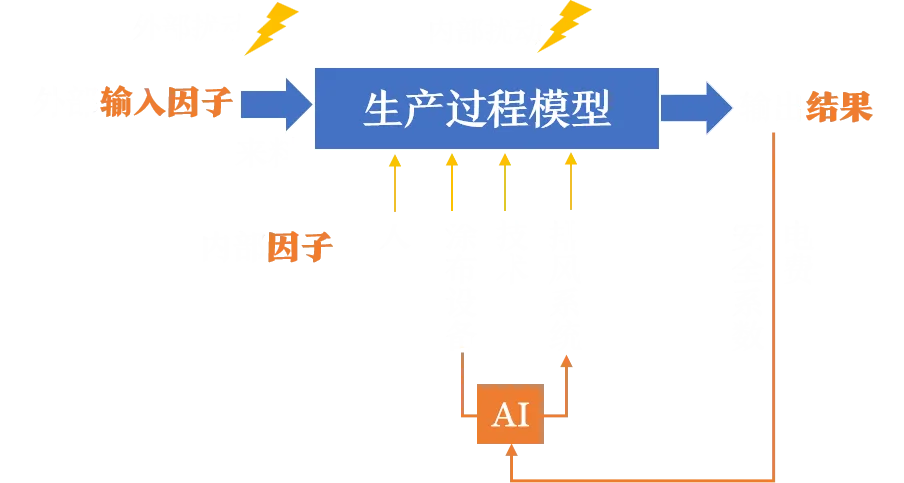
  2. Build the production process model: put the cross-department causality into one model — causes: production speed (manufacturing), exhaust speed (facilities) and other factors; effects: energy consumption and safety (solvent concentration). For the first time both departments shared one causal picture
  3. Close the loop with AI: the model computes the minimum exhaust required for the current production state and feeds the result back to the inputs, optimizing continuously — exhaust went from “always at worst-case maximum” to “supplied as actually needed”

Production process model: input factors flow through the process model to outcomes; AI closes the loop from outcomes back to factors

Results

30% energy saving in the coating process; safety constraints always satisfied (solvent concentration under real-time control); manufacturing and facilities moved from separate margins to data-driven cross-department coordination. The method was later extended to more scenarios, saving roughly 0.8 TWh cumulatively.

Operations

The WEF's First "Lighthouse Factory" in Global Heavy Industry

Central control + flexible lines + digital twin + advanced planning & scheduling

Client: Sany Heavy Industry (construction machinery)

Context

Heavy industry — high-mix, low-volume, asset-heavy — long trailed consumer electronics in line flexibility and operational transparency, with no industry benchmark for digital transformation.

Approach

Founded and led the Industrial Software Institute: a self-developed microservice platform integrating production lines / AGV / MES / SAP; flexible line-control software enabling mass customization; factory digital twin; advanced planning and scheduling built on CPLEX / OptaPlanner.

Results

The digitalization practice helped Sany’s piling-machinery plant become the WEF’s first “Lighthouse Factory” in global heavy industry (2020).